
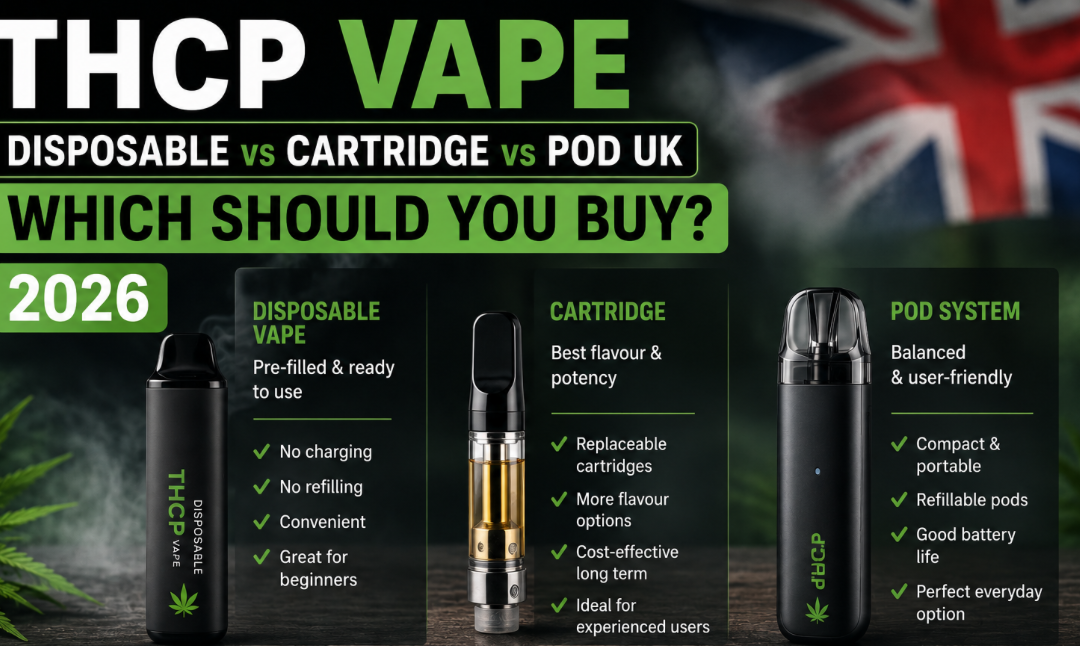
THCP disposable vapes have become an increasingly discussed category within the wider cannabinoid market. Searches for THCP disposable vape UK, THCP vape legality, THCP vape strength and THCP vs THC reflect growing interest in this newer cannabinoid
But THCP is not simply another name for conventional THC.
THCP, short for tetrahydrocannabiphorol, is a distinct cannabinoid that has attracted attention because of its interaction with the body’s cannabinoid receptors and its appearance in newer cannabinoid products.
For UK readers, however, there is an important distinction between what a product is marketed as and whether a particular THCP disposable vape can legally be supplied, sold or possessed in the UK.
This Sluggers Vapes guide explains what THCP is, how disposable vape products are marketed, what to look for when evaluating product information, how THCP compares with other cannabinoids and why UK legal status deserves particular attention. Read Fake THC Vapes
What Is THCP?
THCP stands for tetrahydrocannabiphorol.
It is a naturally occurring cannabinoid that was identified by researchers studying the chemical compounds found in cannabis. THCP has a molecular structure related to THC but is chemically distinct from delta-9 THC.
This distinction is important because cannabinoid products are often marketed using familiar terms such as THC, THCA, HHC, THCP and CBD even though these compounds can have substantially different chemical and regulatory characteristics.
THCP is therefore best understood as a distinct cannabinoid rather than simply a stronger version of conventional THC.
What Is a THCP Disposable Vape?
A THCP disposable vape is a pre-filled vaping device marketed as containing THCP or a THCP-containing cannabinoid formulation.
Disposable products generally combine several components:
- A cannabinoid formulation
- Flavouring or terpene components
- A heating element
- A battery
- A mouthpiece
- A sealed or semi-sealed cartridge/reservoir
The defining feature is that the device is designed as a self-contained vape rather than a refillable system.
However, product descriptions can vary considerably between manufacturers.
A label stating “THCP vape” does not by itself tell you the complete chemical composition of the liquid inside.
Why Are THCP Vapes Becoming Popular?
THCP has attracted attention for several reasons.
Novel cannabinoid interest
Consumers who follow the emerging cannabinoid market are increasingly familiar with compounds beyond traditional THC and CBD.
Product variety
THCP has appeared in several modern cannabinoid formats, including disposable vape products.
Potency marketing
Some retailers and manufacturers market THCP around its perceived potency or receptor activity.
However, potency claims should be treated cautiously.
Laboratory receptor-binding findings do not automatically translate into a predictable human experience, and marketing statements should not be treated as clinical evidence.
Familiar vape format
Disposable vapes are already a familiar product category, making them an obvious format for newer cannabinoids.
THCP vs THC: What’s the Difference?
THCP and THC are chemically related but distinct cannabinoids.
| Characteristic | THCP | Delta-9 THC |
|---|---|---|
| Full name | Tetrahydrocannabiphorol | Delta-9 tetrahydrocannabinol |
| Cannabinoid family | Phytocannabinoid | Phytocannabinoid |
| Chemical structure | Distinct from THC | Distinct compound |
| Psychoactive potential | Reported/expected | Established |
| UK regulatory position | Requires careful current-law assessment | Controlled under UK law |
| Common product formats | Emerging cannabinoid products | Flower, vapes, concentrates and other cannabis products |
| Research base | Relatively limited | Much larger |
The biggest practical difference for consumers is the amount of established evidence.
THC has been studied extensively compared with THCP. Research into THCP and newer cannabinoid products remains considerably more limited.
Is THCP Stronger Than THC?
This is one of the most common THCP searches.
Laboratory research has found that THCP can interact strongly with cannabinoid receptors. However, it is misleading to convert receptor-binding findings directly into a claim that THCP produces a specific number of times the subjective effects of THC in humans.
There is a significant difference between:
receptor activity in laboratory research
and
predictable effects in people.
This is why responsible product information should avoid simplistic claims such as “THCP is exactly X times stronger than THC.”
THCP Disposable Vape Strength
When researching a THCP disposable vape, the word “strength” can mean several different things.
It could refer to:
- THCP concentration
- Total cannabinoid concentration
- Amount of liquid
- Total cannabinoid content
- Marketing claims about potency
- Laboratory-measured cannabinoid levels
These are not interchangeable.
For example, a larger disposable device does not automatically mean that its formulation contains a higher concentration of THCP.
Likewise, a product advertised as “extra strong” should ideally be supported by laboratory documentation rather than relying solely on marketing language.
What Should Be on a THCP Vape COA?
A Certificate of Analysis (COA) is one of the most important documents to examine when researching a cannabinoid product.
A useful laboratory report should provide enough information to identify what was actually tested.
Look for:
Cannabinoid profile
The report should identify the cannabinoids detected and their measured concentrations.
Batch or sample identification
The COA should correspond to the specific product or batch.
Testing laboratory
Look for the identity of the laboratory responsible for the analysis.
Contaminant testing
Depending on the product and laboratory, testing may cover areas such as:
- Heavy metals
- Residual solvents
- Pesticides
- Microbial contamination
Date of testing
Older laboratory documentation may not accurately represent a newer production batch.
Why THCP Vape Lab Testing Matters
The emerging cannabinoid market has created a significant challenge: the product name alone does not establish what’s actually inside a vape.
A product labelled THCP could contain a mixture of cannabinoids, depending on the formulation.
This is why independent laboratory testing is particularly important for novel cannabinoid products.
A good COA should allow the reader to compare the manufacturer’s product description against laboratory results.
THCP Vape Ingredients
A THCP disposable vape may contain more than one cannabinoid.
Depending on the formulation, manufacturers may combine cannabinoids with terpenes and other ingredients.
Potential categories can include:
- THCP
- Other cannabinoids
- Terpenes
- Carrier or formulation ingredients
- Flavouring components
The exact formulation varies between products.
For that reason, never assume that two products labelled “THCP vape” contain identical ingredients.
THCP Vape Flavours
THCP disposable vapes are commonly marketed using flavour profiles familiar from the broader vape and cannabis market.
These can include:
- Fruit
- Citrus
- Berry
- Tropical
- Dessert
- Mint
- Candy-inspired flavours
However, a flavour name does not necessarily tell you which terpenes or flavouring compounds are actually present.
For commercial product comparisons, it is better to describe the manufacturer’s stated flavour profile separately from independently verified laboratory information.
THCP Disposable vs THCP Cartridge
The terms are sometimes used interchangeably, but they can describe different product formats.
THCP Disposable
A disposable device generally contains the battery, heating element and cannabinoid formulation in one integrated product.
THCP Cartridge
A cartridge generally refers to the cannabinoid-containing component designed to work with a compatible battery.
The exact terminology can vary between manufacturers.
For SEO purposes, this distinction is useful because people searching for THCP disposable vapes may be looking specifically for a complete, self-contained device rather than a cartridge.
THCP Disposable vs HHC Vape
THCP and HHC are different cannabinoids.
HHC became widely discussed in the European cannabinoid market before UK authorities and other regulators increased scrutiny of semi-synthetic cannabinoids.
THCP is a separate compound with its own chemical characteristics and regulatory considerations.
This means you should not assume that the legal status or scientific evidence for HHC automatically applies to THCP.
The UK Government has specifically considered semi-synthetic cannabinoids as a broader regulatory category.
THCP vs THCA
THCP and THCA are also fundamentally different.
THCP is a cannabinoid in its own right.
THCA is the acidic precursor associated with THC.
The two compounds therefore should not be treated as interchangeable simply because their names both contain “THC.”
The UK Government has separately considered THCA in its responses to ACMD recommendations, illustrating how quickly the regulatory environment around newer cannabinoids can change.
Are THCP Disposable Vapes Legal in the UK?
This is the most important section for UK readers.
It is risky to make a blanket statement that “THCP vapes are legal in the UK.”
UK controlled-drug law includes rules covering cannabis, controlled cannabinoids and related substances. The Government’s official review of semi-synthetic cannabinoids states that the ACMD recommended that psychoactive semi-synthetic cannabinoids not already captured should be brought within Class B and Schedule I controls through changes to the relevant legislation.
The Government subsequently issued responses to those recommendations, including a further response on 11 May 2026.
This means UK cannabinoid law should be treated as a moving regulatory area, rather than assuming that a cannabinoid is lawful simply because a website sells it.
Why UK Buyers Should Check the Current Law
Novel cannabinoid products can move quickly from niche products to mainstream commercial products.
Regulators may respond through:
- Controlled-drug legislation
- Generic cannabinoid controls
- Product-specific controls
- Consumer protection rules
- Trading Standards enforcement
- Other regulatory frameworks
The Home Office also states that cannabis is a controlled drug and that industrial-hemp licensing does not authorise the use of flowers or leaves as ordinary commercial products.
Therefore, “hemp-derived,” “THC-free,” or “legal cannabinoid” marketing language should not be treated as a substitute for checking the actual UK legal position of the finished product.
What UK Buyers Should Check Before Considering a THCP Vape
For informational and product-comparison purposes, several checks are particularly important.
1. Read the complete cannabinoid profile
Don’t rely on the front of the packaging.
Check what cannabinoids are actually listed.
2. Look for a batch-specific COA
A generic laboratory report is less useful than documentation that clearly corresponds to the product and batch.
3. Check the manufacturer
Look for transparent information about who manufactures the product and where it comes from.
4. Examine the ingredients
The ingredient list should be available and understandable.
5. Check the legal position
A product being advertised online does not automatically establish that it can lawfully be supplied in the UK.
6. Avoid unsupported potency claims
Claims such as “50× stronger” or “stronger than THC” should be treated cautiously unless they are supported by credible scientific evidence.
Red Flags When Researching THCP Disposable Vapes
The emerging cannabinoid market also creates opportunities for misleading product marketing.
Be cautious about products featuring:
No laboratory testing
If there is no credible COA, it becomes difficult to independently verify the cannabinoid profile.
Extremely exaggerated potency claims
Claims based solely on receptor activity or marketing slogans may not accurately describe human effects.
Missing ingredient information
A product should not rely solely on a brand name without providing meaningful ingredient information.
Generic COAs
A laboratory report should correspond to the relevant product or batch.
Unclear manufacturer information
A transparent supply chain is particularly important for novel cannabinoid products.
“100% legal” claims
UK cannabinoid law is complex and evolving. Absolute legal claims should be treated cautiously.
THCP Vape Safety and Research Limitations
One of the biggest differences between THCP and traditional THC is the size of the evidence base.
THC has been studied extensively across pharmacology, medicine and public health.
THCP has a much smaller research literature.
That means there are still important questions around:
- Long-term exposure
- Product-to-product consistency
- Human pharmacology
- Metabolism
- Drug testing
- Interactions with other substances
- Effects of vaping formulations
- Potential contaminants
This limited evidence base is another reason why marketing claims should not be treated as established medical or scientific facts.
Can THCP Show Up on a Drug Test?
This is an important question for anyone subject to workplace, sporting or other drug testing.
There is no universal guarantee that a THCP product will produce a negative drug-test result.
Testing methods differ, and products marketed as THCP may contain other cannabinoids or trace substances.
Therefore, anyone subject to drug testing should not assume that a novel cannabinoid product is automatically undetectable.
THCP Disposable Vape Guide: What Matters Most?
For consumers researching the category, the most useful evaluation framework is:
| Factor | What to Check |
|---|---|
| Cannabinoid | What is actually present? |
| Concentration | Is the stated amount independently tested? |
| COA | Does it correspond to the batch? |
| Ingredients | Are all relevant ingredients disclosed? |
| Manufacturer | Is the company identifiable? |
| Testing | Are contaminants tested? |
| Marketing | Are potency claims supported? |
| Legal status | Is the product currently lawful in the UK? |
| Product format | Disposable or cartridge? |
| Research | How strong is the evidence for the cannabinoid? |
This approach is more useful than simply looking for the product advertised as the “strongest THCP vape.”
Frequently Asked Questions About THCP Disposable Vapes
What is a THCP disposable vape?
It is a self-contained vape product marketed as containing THCP or a THCP-containing cannabinoid formulation.
Is THCP the same as THC?
No. THCP and delta-9 THC are chemically distinct cannabinoids.
Is THCP stronger than THC?
Laboratory research has found strong receptor activity for THCP, but that should not be translated into simplistic claims about exactly how many times stronger its effects are in humans.
Are THCP disposable vapes legal in the UK?
The answer requires careful assessment of current UK legislation and the specific product formulation. UK authorities have been actively reviewing and responding to recommendations concerning semi-synthetic cannabinoids.
What is a THCP COA?
A Certificate of Analysis is laboratory documentation showing test results for a particular sample or batch. It can help verify cannabinoid content and, depending on the testing panel, contaminants.
Can THCP appear on a drug test?
Testing outcomes cannot be guaranteed. Product formulations may contain other cannabinoids, and testing technologies differ.
Are all THCP vapes the same?
No. Products can differ in cannabinoid concentration, ingredients, terpene profile, hardware and manufacturing quality.
Should I trust a “high potency” THCP vape claim?
Not without supporting evidence. A credible COA and transparent cannabinoid profile are more useful than an unsupported marketing claim.
Final Thoughts
The growing interest in THCP disposable vapes reflects the rapid expansion of the novel-cannabinoid market.
But THCP should not be treated as simply another version of conventional THC.
When researching THCP vape products, the most important factors are the actual cannabinoid profile, independent laboratory testing, ingredients, manufacturer transparency, scientific evidence and the current UK regulatory position.
For UK readers, the legal section deserves particular attention. Government and ACMD materials show that semi-synthetic cannabinoids are an active area of UK regulatory review, with recommendations and government responses developing over time.
A commercially useful THCP guide should therefore focus on verified product information rather than unsupported potency claims or assumptions about legality.
Recommended Internal Links
- UK THCP Laws 2026
- THCP vs THC: What’s the Difference?
- THCP vs HHC
- What Is THCP?
- THC Vape COA Guide
- Fake THC Vapes
- THC Vape Troubleshooting
- THC Vape Laws UK 2026
- UK Cannabis Laws 2026
- THCA Laws UK 2026