
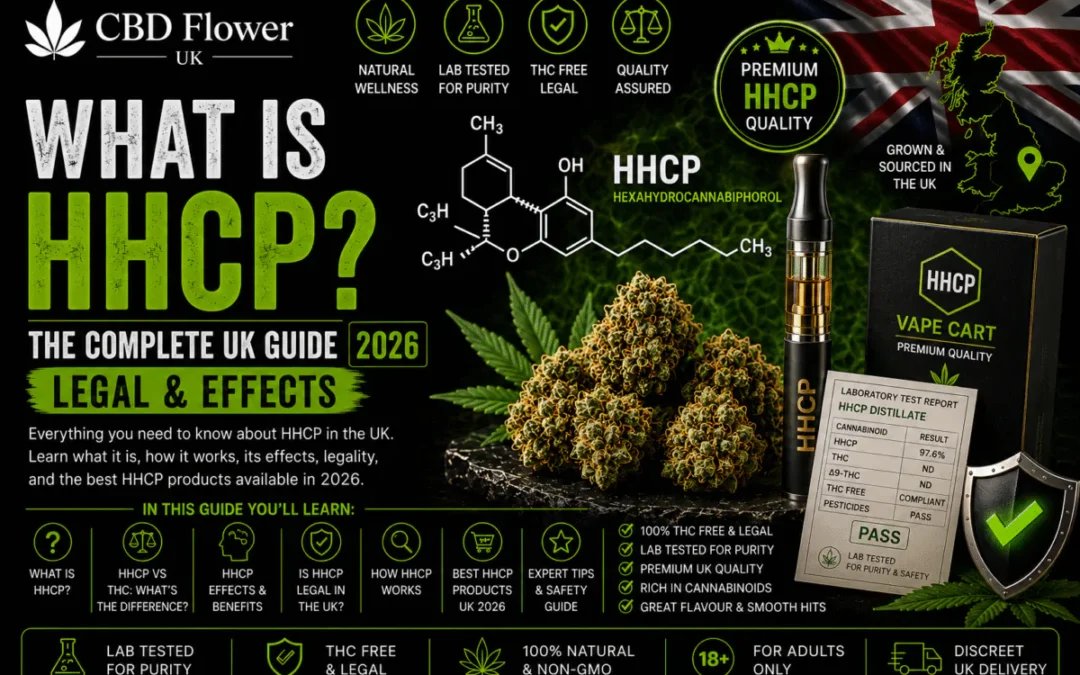
HHCP, short for hexahydrocannabiphorol, is a relatively new cannabinoid that has attracted attention within the wider alternative-cannabinoid market.
If you’re researching what HHCP is, how it differs from other cannabinoids, what HHCP products are, how they are tested, and what UK law says about HHCP, this guide covers the key information in one place.
The UK regulatory position is particularly important in 2026. The UK government has accepted a recommendation to control HHCP and certain related cannabinoids as Class B substances, although implementation requires further legislative action.
Explore our UK Cannabis Laws: A 2026 Guide & THC Flower Complete Guide.
What Is HHCP?
HHCP stands for hexahydrocannabiphorol.
It is a cannabinoid associated with the wider family of THC-related and semi-synthetic cannabinoids. Unlike naturally occurring cannabinoids such as CBD and THC, HHCP is associated with laboratory production rather than occurring naturally in cannabis in meaningful quantities.
The UK’s Advisory Council on the Misuse of Drugs (ACMD) has examined HHCP as part of its review of semi-synthetic cannabinoids.
The ACMD describes HHCP as a synthetic cannabinoid and notes its seven-carbon side chain.
This is important because a cannabinoid being described as “hemp-derived” does not automatically mean that it has the same legal status as CBD or other hemp products.
How Is HHCP Different From Other Cannabinoids?
HHCP is related to several cannabinoids that consumers may already have encountered, including THC, HHC and THCP, but these are different compounds.
A simple way to understand the distinction is:
| Cannabinoid | Full name | General category |
|---|---|---|
| THC | Tetrahydrocannabinol | Naturally occurring cannabinoid |
| HHC | Hexahydrocannabinol | Semi-synthetic cannabinoid |
| THCP | Tetrahydrocannabiphorol | THC-related cannabinoid |
| HHCP | Hexahydrocannabiphorol | Synthetic cannabinoid |
| CBD | Cannabidiol | Naturally occurring, non-intoxicating cannabinoid |
These compounds should not be treated as interchangeable.
Their chemical structures, pharmacological properties, research evidence and legal classifications can differ.
The UK government’s recent review specifically considered HHC, HHCP and related cannabinoids when assessing their appropriate legal controls.
What Are the Reported HHCP Effects?
There is substantially less established human research on HHCP than there is on better-studied cannabinoids such as THC.
Online descriptions may associate HHCP with experiences such as:
- Euphoria
- Relaxation
- Changes in perception
- Sedation
- Altered mood
However, these descriptions should not be interpreted as guaranteed effects.
Individual experiences can vary depending on the cannabinoid formulation, concentration, other ingredients, individual physiology and previous cannabinoid exposure.
There is also limited human evidence from which to establish reliable predictions about how different HHCP products will affect an individual.
Is HHCP Stronger Than THC?
You may see HHCP described online as being “stronger” than THC.
This type of claim should be treated cautiously.
Laboratory findings about cannabinoid receptor activity do not automatically translate into predictable effects in humans. Product concentration and formulation can also vary considerably.
Rather than assuming that HHCP will produce a particular level of effect, it is more accurate to recognise that research into HHCP remains limited.
What HHCP Products Are Available?
HHCP has appeared in various cannabinoid product formats, particularly in markets where alternative cannabinoids have been sold.
Reported formats have included:
- Disposable vapes
- Vape cartridges
- Edible products
- Concentrate-style products
- Other cannabinoid formulations
However, availability is not the same thing as legal approval.
A product appearing on a website or marketplace does not automatically mean that its possession, importation, manufacture or supply is lawful.
This distinction is particularly important for HHCP because its UK regulatory position is changing.
HHCP Product Quality and Testing
When researching any cannabinoid product, product transparency is important.
Where applicable, look for:
- Clear cannabinoid information
- Batch or lot identification
- Manufacturer information
- Ingredient information
- Appropriate laboratory testing
- Accurate product labelling
- Relevant safety documentation
A Certificate of Analysis (COA) can provide useful information about the contents of a particular tested batch.
Depending on the laboratory, testing may provide information about cannabinoid concentrations and other quality parameters.
However, a COA does not by itself establish that a product is legally permitted for sale in the UK.
For more information, see our guide to How to Read a Cannabis COA.
Is HHCP Legal in the UK?
The UK legal position is changing.
This is one of the most important considerations when researching HHCP.
The UK government has accepted the ACMD recommendation that HHCP should be controlled as a Class B substance under the Misuse of Drugs Act 1971.
The government response states that implementation will take place when parliamentary time allows.
The recommendation includes HHCP alongside several related cannabinoids.
This means older articles claiming simply that “HHCP is legal in the UK” may no longer provide an accurate picture of the current regulatory situation.
There is an important difference between:
- Existing legislation
- Government policy
- An accepted recommendation
- Legislation that has actually entered into force
For that reason, UK consumers should check the latest official legislation and government guidance when researching HHCP.
Why Is HHCP Being Controlled?
The ACMD reviewed a number of semi-synthetic cannabinoids and related compounds as part of its assessment of potential harms and appropriate legal controls.
HHCP was included among the compounds recommended for control.
The government’s response subsequently accepted the recommendation to control HHCP as a Class B substance.
This is why the legal status of newer cannabinoids cannot be determined simply by asking whether a substance originates from hemp.
The specific chemical compound and applicable legislation need to be considered.
HHCP and UK Vape Regulation
Cannabinoid law and general vaping regulation are separate issues.
The Tobacco and Vapes Act 2026 establishes a broader framework relating to vaping and nicotine products and provides powers concerning product requirements, advertising and enforcement.
Government guidance also states that changes concerning the age of sale for vaping and nicotine products will apply from 29 October 2026.
These regulations should not be interpreted as making HHCP lawful.
Vaping regulation and controlled-drug legislation are separate legal questions.
HHCP vs CBD
CBD and HHCP should not be confused.
CBD is a naturally occurring cannabinoid that is widely used in UK consumer products subject to applicable regulations.
HHCP is a different cannabinoid associated with synthetic production and has a substantially different regulatory position.
A product being described as a “hemp cannabinoid” does not make it legally equivalent to CBD.
What Should UK Consumers Check When Researching HHCP?
If you’re researching HHCP products or alternative cannabinoids, consider the following:
Check the Exact Cannabinoid
Read the product information carefully and identify whether it contains HHCP, HHC, THCP, THC, CBD or another compound.
Check Batch Information
Batch or lot information can help connect a product with relevant testing documentation.
Check Laboratory Information
Where available, review appropriate laboratory reports and COAs.
Check Ingredients
Look beyond the headline cannabinoid and review the complete ingredient list.
Check Current UK Legislation
Don’t rely on old blog posts or retailer claims about cannabinoid legality.
HHCP’s UK regulatory position has been subject to significant change.
Be Careful With Marketing Claims
Claims such as “100% legal,” “completely safe” or “guaranteed effects” should be treated cautiously.
Scientific evidence and legislation do not necessarily support these simplified claims.
Frequently Asked Questions About HHCP
What does HHCP stand for?
HHCP stands for hexahydrocannabiphorol, a cannabinoid associated with synthetic production.
Is HHCP the same as THC?
No. HHCP and THC are different cannabinoids with different chemical structures.
Is HHCP the same as HHC?
No. HHC and HHCP are different but chemically related cannabinoids.
Is HHCP the same as THCP?
No. HHCP and THCP are separate cannabinoids, despite their similar names.
Is HHCP legal in the UK?
The government has accepted the recommendation to control HHCP as a Class B substance, but implementation requires further legislative action. The legal position should therefore be checked against the latest UK legislation.
Is HHCP natural?
The ACMD describes HHCP as a synthetic cannabinoid rather than a cannabinoid occurring naturally in cannabis in meaningful quantities.
Does HHCP produce psychoactive effects?
HHCP is considered psychoactive, but human research remains limited. Individual responses can vary and should not be predicted solely from online marketing descriptions.
Final Thoughts on HHCP in the UK
HHCP is part of a relatively new group of cannabinoids that has attracted attention because of its relationship to other THC-related compounds.
The most important things to understand are what HHCP is, how it differs from related cannabinoids, the limitations of current research, how cannabinoid products can be evaluated, and the changing UK regulatory position.
For UK readers, the legal section is particularly important. The government has accepted the recommendation to control HHCP as a Class B substance, with implementation dependent on the legislative process.