
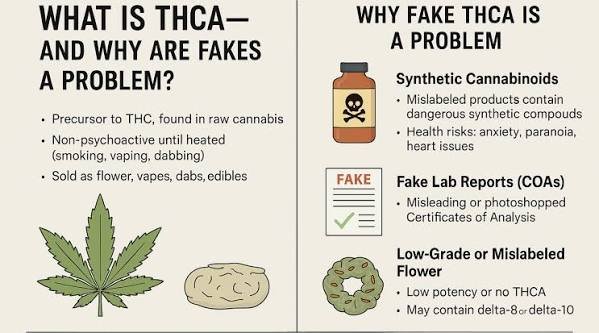
This Sluggers Carts guide explains how to identify potential fake THCA products, what to look for when checking a product listing and why independent laboratory information matters.
If you’re searching for fake THCA products in the UK, you’re not alone. As interest in THCA flower, concentrates and other cannabinoid products has increased, so has the importance of knowing what you’re actually buying.
Products marketed as THCA can vary considerably in quality, labelling, cannabinoid content and supporting documentation. A professional-looking package does not automatically prove that the contents match the label.
For UK consumers, the safest approach is to look beyond packaging and marketing claims and examine product information, batch details, laboratory testing and the seller’s transparency.
This Sluggers Carts guide explains how to identify potential fake THCA products, what to look for when checking a product listing and why independent laboratory information matters.
UK legal note: Cannabinoid regulation is complex and changing. The Advisory Council on the Misuse of Drugs has recommended controls covering THCAs, and the UK Government published a further response on the issue in May 2026. Do not assume that a product is lawful simply because it is labelled “THCA” or described as hemp-derived.
What Are Fake THCA Products?
A fake THCA product is generally a product that is misrepresented in some important way.
For example, the product may:
- Contain substantially different cannabinoids from those advertised
- Have inaccurate potency information
- Use a misleading product name
- Display questionable or unverifiable laboratory results
- Have missing batch information
- Use copied branding or packaging
- Make claims that cannot be independently verified
- Contain ingredients that are not properly disclosed
Not every poor-quality product is necessarily counterfeit. Some products may simply have inadequate labelling or quality-control information.
The key issue is whether the product can be independently verified.
Why Are Fake THCA Products a Concern?
THCA is a cannabinoid precursor associated with THC. The Home Office has previously explained that THCA itself and THC require careful consideration under UK controlled-drug legislation, particularly because THCA can convert to THC through heat or other environmental changes.
That makes accurate product information particularly important.
A product labelled with a high THCA percentage should ideally be supported by credible testing that identifies:
- Cannabinoid concentrations
- THC content where relevant
- Batch or lot information
- Testing date
- Laboratory identity
- Relevant contaminants or safety parameters
- Product/sample identification
Without supporting information, a percentage printed on a package is simply a claim.
How to Spot Fake THCA Products
1. Check for Batch-Specific Laboratory Results
One of the strongest things to look for is a batch-specific Certificate of Analysis (COA) or equivalent laboratory report.
A useful report should allow you to connect the test results to the actual product or batch being sold.
Look for information such as:
- Batch number
- Sample identification
- Testing date
- Cannabinoid profile
- Laboratory name
- Test method or analytical information
- Relevant contaminant testing
A generic laboratory document that does not correspond to the product you’re considering provides much less confidence.
2. Be Careful With Extremely High Potency Claims
Another warning sign is an unusually high cannabinoid percentage accompanied by little or no supporting evidence.
Don’t judge authenticity based solely on a large number printed on a product page.
Instead, ask:
Can the advertised cannabinoid profile be supported by a laboratory report?
A credible product listing should make it possible to understand what was actually tested rather than relying entirely on marketing language.
3. Check Whether the COA Matches the Product
A laboratory report should make sense alongside the product listing.
For example, check whether:
Product name → Batch number → Laboratory report → Cannabinoid profile
all correspond.
If the product is called one thing on the website but the COA refers to an unrelated sample, that should prompt further questions.
4. Look for Missing Batch Information
Batch information is useful because it helps connect the physical product with its testing documentation.
Be cautious when a seller provides:
- No batch number
- No production information
- No laboratory documentation
- A generic COA covering an entire range of products
- A COA that cannot be connected to the item being sold
The more difficult it is to trace a product, the harder it becomes to independently verify the claims.
5. Examine the Product Packaging
Packaging can provide useful clues, but it should not be your only authenticity check.
Look for:
- Clear product identification
- Batch or lot information
- Ingredient information where applicable
- Manufacturer or supplier information
- Consistent branding
- Clear product specifications
- Appropriate warnings and labelling
Poor printing, spelling mistakes or inconsistent branding may be warning signs, but professional packaging can also be copied.
That’s why laboratory and traceability information matter more than appearance alone.
Fake THCA Flower: What Should You Check?
THCA flower can be particularly difficult to evaluate from appearance alone.
Two flowers can look very similar while having significantly different cannabinoid profiles.
When evaluating THCA flower, consider:
Cannabinoid Profile
Look for documented cannabinoid results rather than relying only on a product title.
Batch Information
The batch number should connect the product to its testing documentation.
Laboratory Testing
Look for appropriate testing information from an identifiable laboratory.
Product Description
A good product description should provide useful information about the product rather than relying entirely on claims such as “premium,” “ultra strong” or “100% authentic.”
Storage and Packaging
The condition and packaging of the product can provide additional information, although they cannot independently prove authenticity.
Fake THCA Vapes and Disposable Products
The same principles apply when evaluating THCA vape products.
A vape listing should provide clear information about what the product contains rather than simply relying on a cannabinoid name.
Before considering a product, look for:
- Cannabinoid information
- Ingredient information
- Product size
- Batch information
- Laboratory documentation where provided
- Manufacturer or supplier information
- Clear product specifications
Be especially cautious of products that make unusually broad claims about potency or effects without supporting documentation.
Why a COA Matters for Vape Products
A laboratory report can provide information that cannot be determined simply by looking at a vape cartridge or disposable.
For example, testing may identify the cannabinoid profile and, depending on the testing scope, relevant contaminants or other quality parameters.
This is one reason consumers should treat lab testing as part of product verification rather than a marketing badge.
Fake THCA COAs: Warning Signs
A COA can provide useful information, but consumers should also examine the document itself.
Potential warning signs include:
- No laboratory name
- No testing date
- No batch or sample number
- No product identification
- Missing cannabinoid results
- Poorly presented or incomplete documentation
- Results that do not match the product description
- A document that appears to cover an unrelated product
- No way to verify the laboratory or report
A PDF labelled “lab tested” isn’t automatically proof of authenticity.
The important question is whether the report can be connected to the product being sold.
How to Choose a More Transparent THCA Product
If you’re comparing different products, focus on traceability rather than marketing language.
A more transparent product listing should make it easy to find information about:
Product → Batch → Testing → Cannabinoid profile → Supplier
You should also be able to find clear information about the seller, ordering process, product specifications and applicable policies.
This is more useful than simply choosing the product with the biggest potency claim.
Fake THCA Products vs Poor-Quality Products
It’s important to distinguish between counterfeit products and poorly documented products.
A product can be genuine but still have inadequate documentation.
For example, a seller might provide poor-quality product descriptions without necessarily selling a counterfeit item.
Likewise, attractive packaging does not prove that a product is authentic.
For consumers, the practical question is:
Can the product claims be independently supported?
That’s why batch information and credible laboratory documentation are valuable.
What Should a Good THCA Product Listing Include?
When comparing UK cannabinoid product listings, look for detailed product information such as:
- Product name
- Product type
- Cannabinoid information
- Strain or cultivar information where applicable
- Terpene information where available
- Product weight or volume
- Batch information
- Laboratory testing information
- Packaging information
- Seller information
- Relevant delivery information
- Applicable legal and regulatory information
A detailed product page makes it easier for customers to make an informed decision.
THCA UK Legal Status: Why You Should Check Before Buying
The legal position surrounding THCA in the UK requires particular care.
The Home Office has previously stated that pure THCA, as an isolated substance, was not controlled under the Misuse of Drugs Act 1971 in the circumstances described in its guidance, while also explaining that THCA can convert to THC.
More recently, the Advisory Council on the Misuse of Drugs recommended that THCAs be controlled under the Misuse of Drugs Act 1971 and associated regulations. The government published a further response on that recommendation in May 2026.
Therefore, consumers should not rely on the phrase “THCA” as proof of legality.
The legal position can depend on the specific cannabinoid, product composition, form, intended use and applicable UK legislation.
This article is general information and is not legal advice.
How Sluggers Carts Approaches Product Information
When comparing cannabinoid products online, customers should look for clear product information rather than relying exclusively on branding.
For products available through Sluggers Carts, customers can review the individual product listing for the information provided about the product, specifications and available testing information.
You can also explore our THC vape collection to compare available products.
For broader information, our THC & Cannabis Guides UK section can provide additional educational content.
Fake THCA Products FAQ
How can I tell if THCA flower is fake?
Start by checking whether the product has traceable batch information and credible laboratory documentation. Compare the product description with the cannabinoid results and check whether the testing information actually corresponds to the product.
Can you tell if THCA is fake from its appearance?
No. Appearance alone cannot reliably establish cannabinoid content or authenticity. Laboratory testing and traceability provide more useful information.
Is a COA proof that a THCA product is genuine?
Not automatically. A COA is useful when it can be connected to the relevant product or batch and comes from an identifiable testing laboratory. A generic or unverifiable document provides much less assurance.
What should a THCA COA show?
Depending on the testing scope, useful information can include cannabinoid concentrations, sample identification, batch information, testing date and laboratory details.
Are THCA products legal in the UK?
The legal position is complex and has been subject to recent regulatory developments. The ACMD has recommended controls for THCAs, and the Government responded further to those recommendations in May 2026. Consumers should check current UK legislation rather than assuming that a THCA label makes a product lawful.
What is the biggest warning sign when buying THCA online?
One of the biggest warning signs is a lack of verifiable product information. If a seller makes strong potency or authenticity claims but cannot provide meaningful batch, testing or product information, consumers should be cautious.
Final Thoughts On fake THCA products
The best way to approach fake THCA products in the UK is to look beyond packaging and marketing.
Check the product information, examine batch details, look for appropriate laboratory testing and make sure the available documentation actually relates to the product you’re considering.
Most importantly, don’t assume that a product is authentic or legally marketable simply because it is labelled THCA.
As UK cannabinoid regulation continues to develop, consumers should check current legal requirements and rely on transparent, verifiable product information when evaluating cannabinoid products.