
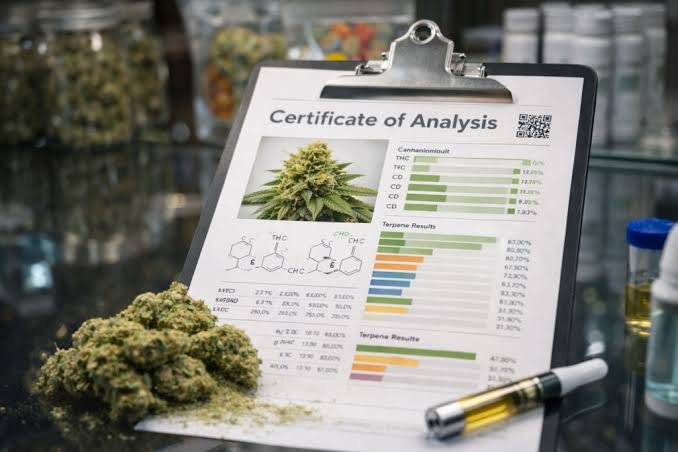
When shopping for THCA products online, you may come across the term COA, short for Certificate of Analysis. A COA is a laboratory report containing analytical results for a particular product or batch.
For customers comparing THCA products, learning how to read a COA can make it easier to understand the cannabinoid profile, potency information and laboratory testing associated with a product.
A good COA should provide more than one headline number. Depending on the product and laboratory, it may contain cannabinoid results alongside testing for contaminants such as pesticides, heavy metals, residual solvents and microbial contaminants.
This Sluggers Carts guide explains how to read a THCA COA, what the main sections mean and what UK customers should check before choosing a THCA product.
What Is a THCA COA?
A THCA COA, or Certificate of Analysis, is a laboratory report showing the results of testing performed on a cannabis or hemp-derived product.
A COA may include:
- THCA percentage
- Delta-9 THC percentage
- Total THC
- CBD and other cannabinoids
- Terpene information
- Pesticide screening
- Heavy-metal testing
- Residual-solvent testing
- Microbial testing
- Batch or lot number
- Testing date
- Laboratory information
The exact testing panel varies between laboratories and products.
The most useful COAs are traceable to the specific product or batch rather than being generic reports covering an entire product range.
Why Should You Check a THCA COA?
A product description tells you what a seller says about a product.
A laboratory report provides analytical information about what was tested.
That distinction matters when comparing THCA flower, THCA concentrates, THCA diamonds and other cannabinoid products.
A COA can help you check whether the advertised cannabinoid profile corresponds with the laboratory results and whether the product has been screened for particular contaminants.
It should be considered part of the product-information process rather than a standalone guarantee of quality, safety or legality.
How to Read a THCA COA
The easiest approach is to work through the report section by section.
1. Check the Laboratory Information
Start at the top of the COA.
Look for information such as:
- Laboratory name
- Laboratory address
- Report or certificate number
- Testing date
- Sample identification
- Testing methods
- Accreditation or quality information where provided
A transparent report should make it possible to identify who performed the testing and what sample was analysed.
Don’t focus only on the large cannabinoid percentage printed in the middle of the page.
The supporting information is important because it helps establish what was actually tested.
2. Check the Batch or Lot Number
One of the most important details on a COA is the batch or lot number.
Ideally, the batch number shown on the laboratory report should correspond with the batch information on the product packaging or product documentation.
For example:
Product: THCA Flower
Batch: ABC123
COA: ABC123
This creates a traceable connection between the laboratory report and the product being sold.
A generic COA that doesn’t identify the relevant batch provides less useful information.
3. Look at the Cannabinoid Profile
The cannabinoid section is usually the part customers notice first.
Depending on the laboratory and product, you may see results for:
- THCA
- Delta-9 THC
- CBD
- CBDA
- CBG
- CBGA
- CBC
- CBN
- Other cannabinoids
Results may be displayed as percentages, milligrams per gram or other units.
What Does THCA % Mean?
THCA is the acidic precursor associated with THC.
A COA might show a result such as:
THCA: 20.5%
This means the laboratory measured approximately 20.5% THCA in the tested sample under the stated analytical method.
However, don’t automatically treat the THCA percentage as equivalent to the amount of active delta-9 THC that would be present without considering the chemistry of decarboxylation.
4. Understand THCA vs Total THC
This is one of the most important parts of reading a THCA COA.
THCA and delta-9 THC are different measurements.
THCA can convert to THC when exposed to heat through a process known as decarboxylation.
Some laboratory reports therefore include a calculated total THC value.
A commonly used calculation is based on the molecular-weight relationship between THCA and THC:
Total THC = Delta-9 THC + (THCA × 0.877)
For example, if a hypothetical laboratory report showed:
- THCA: 20%
- Delta-9 THC: 0.2%
the calculated value would be approximately:
0.2 + (20 × 0.877) = 17.74%
This calculation is useful for understanding cannabinoid chemistry, but do not use a mathematical calculation alone to determine whether a product is legal in the UK.
UK controlled-drug rules and product-specific requirements are a separate legal question.
5. Check Delta-9 THC
Look specifically for the Delta-9 THC result.
It may appear as:
- Δ9-THC
- Delta-9 THC
- THC
- Δ9 THC
Make sure you understand which THC measurement the laboratory is reporting.
Don’t assume that a product advertised as “THCA” contains no THC.
The COA should show the laboratory’s measured cannabinoid results.
6. Look for Other Cannabinoids
A comprehensive cannabinoid panel may show more than THCA and THC.
You may see:
CBD — cannabidiol
CBG — cannabigerol
CBN — cannabinol
CBC — cannabichromene
The presence of additional cannabinoids can help provide a more complete picture of the tested cannabinoid profile.
However, a particular cannabinoid appearing on a COA does not automatically mean that it provides a particular effect or health benefit.
7. Check the Terpene Profile
Some THCA flower COAs also include a terpene profile.
Terpenes are aromatic compounds naturally found in cannabis and many other plants.
A terpene section may list compounds such as:
- Myrcene
- Limonene
- Caryophyllene
- Linalool
- Pinene
- Humulene
The results may be shown individually and sometimes as a total terpene percentage.
If you’re comparing THCA flower products, the terpene panel can be useful alongside the cannabinoid profile because it gives you additional information about the composition of the sample.
8. Check Pesticide Testing
A COA may contain a pesticide panel.
Depending on the laboratory, dozens of individual pesticides may be screened.
Look for:
- The substances tested
- Detection limits
- Individual results
- Pass/fail interpretation where provided
A report showing that pesticides were not detected above the laboratory’s reporting limits is different from claiming that a product contains absolutely zero pesticide molecules.
The wording and detection limits matter.
9. Check Heavy-Metal Results
Cannabis and hemp plants can absorb substances from their growing environment, which is why heavy-metal screening can be an important part of product testing.
A COA may test for metals including:
- Lead
- Arsenic
- Cadmium
- Mercury
Look at the actual results and the units used.
If the report provides limits or pass/fail criteria, check those alongside the measured values.
10. Check Residual Solvents
Residual-solvent testing is particularly relevant to products that have undergone extraction or processing.
Depending on the product and testing method, a laboratory may screen for substances such as:
- Ethanol
- Hexane
- Acetone
- Butane
- Other processing solvents
A flower product and a highly processed extract may have different testing requirements, so don’t expect every COA to contain exactly the same panels.
11. Check Microbial Testing
Some laboratory reports include microbiological testing.
This may screen for organisms or contaminants such as:
- Yeast
- Mold
- Aspergillus
- E. coli
- Salmonella
Again, the exact panel depends on the laboratory, sample type and testing protocol.
For customers comparing products, the presence of relevant microbial testing can provide additional information about the testing process.
What Makes a THCA COA Look More Complete?
When comparing COAs, look for several pieces of information together rather than focusing on one number.
A useful checklist is:
Product identification
Does the report clearly identify the sample?
Batch information
Does the batch or lot reference correspond with the product?
Laboratory information
Can you identify the laboratory that performed the analysis?
Testing date
Is there a clear sample or report date?
Cannabinoid panel
Are THCA, delta-9 THC and other relevant cannabinoids reported?
Contaminant testing
Does the report include relevant pesticide, heavy-metal, residual-solvent or microbial screening?
Units and detection limits
Can you understand how the results are expressed?
Testing methods
Does the report identify the analytical method or methodology used?
The more traceable the report is, the easier it is to understand what the laboratory actually tested.
How to Spot a Weak or Unclear THCA COA
Be cautious when a supposed COA:
- Has no laboratory name
- Has no testing date
- Has no batch number
- Doesn’t identify the product
- Only shows a single potency number
- Uses unexplained units
- Contains obvious inconsistencies
- Cannot be connected to the product being sold
- Makes legal or medical claims that the laboratory report itself does not establish
A professional-looking PDF is not automatically evidence of a comprehensive laboratory analysis.
The underlying information matters more than the appearance of the document.
Does a THCA COA Prove a Product Is Legal in the UK?
No.
This is an important distinction.
A COA provides laboratory testing information. It does not, by itself, constitute legal certification.
UK cannabis and cannabinoid rules can depend on the specific substance, product composition, intended use and applicable legislation.
For example, the Food Standards Agency separately regulates CBD foods under the novel-food framework, and current FSA guidance states that CBD food products require authorisation before they can be legally sold in Great Britain.
THCA products should therefore not be described as UK-legal simply because a COA shows a particular cannabinoid result.
If you’re unsure about the legal position of a particular product, check current UK government guidance and obtain appropriate professional legal advice.
How to Compare THCA Products Using COAs
If you’re shopping for THCA products, don’t compare products based solely on advertised potency.
Instead, compare the available laboratory information.
For example, you might compare:
| COA Check | Product A | Product B |
|---|---|---|
| THCA result | Check report | Check report |
| Delta-9 THC | Check report | Check report |
| Other cannabinoids | Check report | Check report |
| Terpenes | Check report | Check report |
| Pesticides | Check report | Check report |
| Heavy metals | Check report | Check report |
| Residual solvents | Check report | Check report |
| Microbial testing | Check report | Check report |
| Batch number | Match product | Match product |
| Test date | Check | Check |
This approach gives you a much better basis for comparing products than relying on marketing language alone.
Why Batch-Specific Testing Matters
Imagine a retailer has a COA showing excellent results for a particular THCA flower.
That doesn’t necessarily mean every future batch of the same product has identical laboratory results.
Cannabis and hemp products can vary between production batches.
A batch-specific report provides a more direct connection between the laboratory analysis and the product being offered.
That’s why customers should look for a COA that can be traced to the relevant product or batch whenever testing documentation is provided.
THCA COA FAQs
What does COA mean in cannabis products?
COA stands for Certificate of Analysis. It is a laboratory report containing analytical results for a specific sample or batch.
What should I look for on a THCA COA?
Start with the laboratory information, testing date, batch number, cannabinoid profile, THCA, delta-9 THC, total THC where reported, and relevant contaminant testing.
Does a COA prove THCA flower is legal?
No. A COA provides laboratory results; it does not independently establish the legal status of a product in the UK.
Is THCA the same as THC?
No. THCA is the acidic precursor associated with THC. Heating can cause decarboxylation, converting THCA into THC.
What does THCA percentage mean?
It represents the measured concentration of THCA in the tested sample, usually expressed as a percentage by weight.
Why does my COA show both THCA and THC?
Because they are different cannabinoids and can be measured separately. A laboratory may report both measurements to provide a more complete cannabinoid profile.
Should a THCA COA include pesticide testing?
Where pesticide testing is part of the laboratory’s product testing programme, the report may show individual pesticide results, reporting limits and/or pass/fail interpretations.
Can I trust a COA without a batch number?
A COA without clear product or batch identification is less useful for verifying that the report relates to the specific product you’re considering.
Final Thoughts: How to Read a THCA COA
Learning how to read a THCA COA gives you a better way to evaluate cannabinoid products beyond the claims on a product page.
Start with the laboratory and batch information. Then review the cannabinoid profile, including THCA and delta-9 THC. After that, look at the terpene profile and relevant contaminant testing such as pesticides, heavy metals, residual solvents and microbial screening.
Most importantly, remember that a COA is testing documentation, not a guarantee of legality, safety or product performance.
For UK customers, laboratory results should be considered alongside current UK requirements and the specific information supplied for the product.
Explore More THCA & Cannabis Guides
If you want to learn more before choosing a cannabinoid product, explore our related THCA for information about cannabinoid profiles, product formats, testing and UK considerations.
You can also browse our available product categories and review the product information provided before making a purchasing decision.