
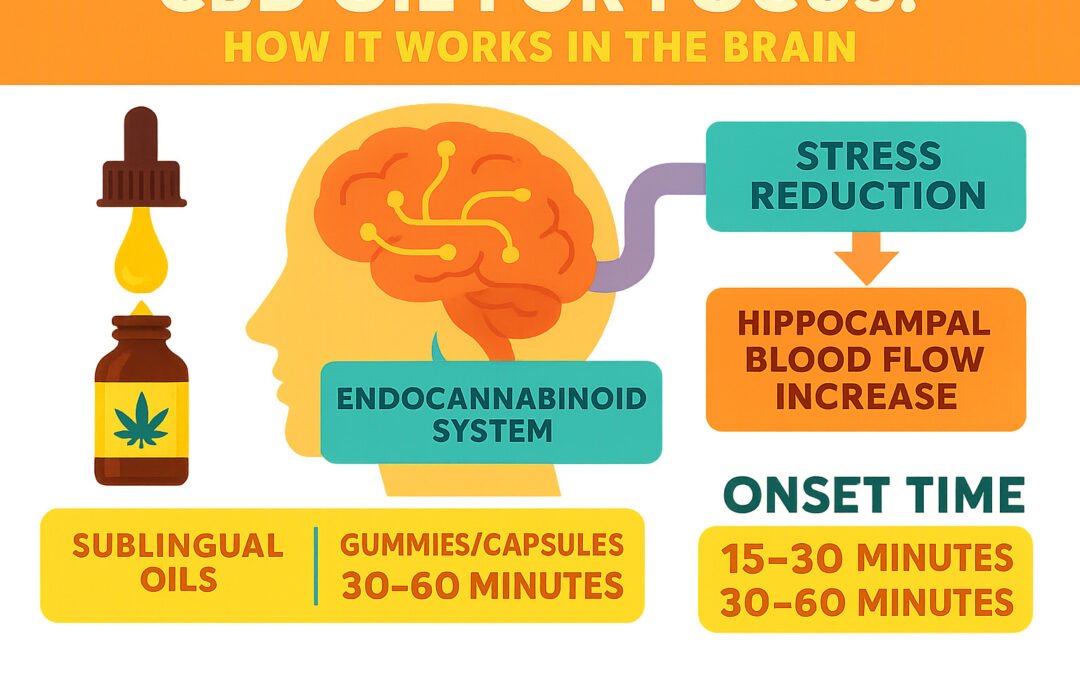
If you’re searching for CBD for focus, you’re probably looking for something that can fit into a busy day without the stimulation associated with traditional energy products.
CBD has become increasingly popular in the UK, with oils, capsules, gummies and other cannabinoid products marketed around relaxation, balance and everyday wellbeing.
But does CBD actually improve concentration?
The answer is more complicated than many product descriptions suggest.
CBD, or cannabidiol, is not an established cognitive enhancer, and there is currently insufficient evidence to claim that ordinary CBD products reliably improve attention, concentration or productivity. Research into cannabinoids and cognition is still developing, while evidence from cannabis studies involving THC cannot simply be applied to CBD products.
That doesn’t mean CBD isn’t worth researching.
For consumers interested in clarity and calm, the more useful question is how different CBD products compare, what to look for when evaluating quality and what the current UK evidence and regulations actually say. Read CBD for Anxiety Guide.
CBD for Focus at a Glance
| CBD option | Why consumers consider it | What to check |
|---|---|---|
| CBD Oil | Convenient and easy to compare | CBD content, ingredients and COA |
| CBD Capsules | Simple, consistent format | Ingredient list and cannabinoid content |
| CBD Isolate | Primarily CBD without a broad cannabinoid profile | Purity and testing |
| Broad-Spectrum CBD | Contains multiple hemp compounds | Cannabinoid profile and THC results |
| Full-Spectrum CBD | Wider hemp-derived cannabinoid profile | THC and controlled-cannabinoid testing |
| CBD Gummies | Convenient and familiar format | CBD amount, ingredients and regulatory status |
There isn’t currently a scientifically established “best CBD for focus.”
Instead, product selection should be based on transparency, quality, cannabinoid composition and your reason for considering CBD in the first place.
What Is CBD?
CBD stands for cannabidiol.
It is one of the cannabinoids naturally found in hemp and cannabis.
Unlike THC, CBD does not produce the characteristic intoxicating high associated with THC.
CBD is being investigated for a range of potential effects, including its interaction with systems involved in mood, stress, sleep and neurological function.
However, CBD should not automatically be described as a stimulant or nootropic.
If a product claims that CBD will dramatically increase concentration, productivity or mental performance, it is worth looking closely at the evidence behind that claim.
Does CBD Actually Improve Focus?
This is where CBD marketing and scientific evidence can diverge.
There is currently no strong clinical evidence establishing ordinary CBD products as reliable focus or concentration enhancers.
Research into cannabis and cognition is also complicated because studies often involve THC-containing cannabis rather than CBD alone.
For example, a 2026 systematic review examining recovery after cannabis cessation found that attention and executive-function effects can persist following heavy cannabis exposure, highlighting why evidence involving cannabis as a whole should not be interpreted as evidence that CBD itself improves cognition.
Similarly, research involving THC and brain function cannot simply be transferred to CBD products.
The important distinction
CBD research ≠ THC research.
When evaluating a CBD product marketed for focus, look for evidence specifically involving CBD rather than relying on general statements about cannabis.
CBD for Clarity and Calm: What Does That Mean?
The phrase “clarity and calm” is often more appropriate for CBD marketing than claiming that CBD directly boosts concentration.
Why?
Because focus isn’t simply about increasing stimulation.
People can struggle to concentrate because of:
- Stress
- Poor sleep
- Distractions
- Anxiety
- Fatigue
- Workload
- Environmental factors
- Other health issues
A product that is marketed around calmness may therefore appeal to people who want to create a more relaxed environment for work or study.
That is different from saying CBD directly improves cognitive performance.
CBD Oil for Focus
CBD oil remains one of the most popular CBD formats.
A typical CBD oil combines CBD extract with a carrier oil.
Depending on the formulation, the product may contain:
- CBD isolate
- Broad-spectrum CBD
- Full-spectrum hemp extract
- Other naturally occurring cannabinoids
- Terpenes
For consumers interested in CBD for focus, CBD oil is particularly useful as a comparison category because manufacturers usually disclose the CBD concentration clearly.
What should you look for?
Check:
CBD concentration:
How much CBD does the product actually contain?
Ingredients:
What carrier oil and additional ingredients are included?
Cannabinoid profile:
Is the product isolate, broad-spectrum or full-spectrum?
THC information:
Does independent testing show the THC content?
COA:
Can the manufacturer’s claims be verified through laboratory testing?
CBD Isolate for Focus
CBD isolate is a highly purified form of cannabidiol.
It is attractive to consumers who want a relatively simple cannabinoid profile without the wider range of compounds found in full-spectrum extracts.
Potential advantages
CBD isolate products can make it easier to understand exactly what cannabinoid the product is centred around.
They may therefore appeal to people who want:
- A simple formulation
- No broad cannabinoid blend
- Clear CBD labelling
- Minimal plant-derived compounds
However, CBD isolate isn’t scientifically proven to improve concentration simply because it contains a higher proportion of CBD.
Purity and cognitive effectiveness are two different questions.
Broad-Spectrum CBD for Focus
Broad-spectrum CBD products typically contain CBD alongside other hemp-derived compounds while being formulated without intentionally added THC.
This can provide a broader cannabinoid profile than isolate.
When comparing broad-spectrum products, don’t rely exclusively on the term “THC-free.”
Instead, look at the independent laboratory report.
A good COA can provide a clearer picture of which cannabinoids were actually detected.
Full-Spectrum CBD for Focus
Full-spectrum CBD contains CBD alongside other naturally occurring hemp compounds.
Depending on the product, this can include other cannabinoids and trace THC.
This makes laboratory testing particularly important for UK consumers.
A full-spectrum label doesn’t automatically tell you the precise cannabinoid composition.
The COA should provide the more useful information.
CBD vs Caffeine for Focus
CBD and caffeine are often compared because they’re associated with very different approaches to daytime consumption.
Caffeine is a stimulant and is widely used to increase alertness.
CBD is not a conventional stimulant.
This means CBD shouldn’t be marketed as a natural replacement for coffee or energy drinks.
If your goal is specifically alertness, caffeine and CBD have fundamentally different pharmacological profiles.
If your goal is calmness, comparing the two purely on “energy” doesn’t make much sense.
The better approach is to identify what you’re actually trying to change:
Alertness?
Stress?
Relaxation?
Sleep quality?
Concentration?
These are different goals.
CBD for Focus vs CBD for Anxiety
The two searches may look similar, but they represent different consumer needs.
Someone searching for CBD for anxiety may be interested primarily in relaxation.
Someone searching for CBD for focus may be interested in maintaining concentration without feeling overstimulated.
CBD research is more commonly discussed in relation to anxiety than direct cognitive enhancement, but even the anxiety evidence remains incomplete.
That means marketers should avoid turning “calm” into an unsupported claim that CBD directly improves productivity.
Could Calmness Help You Focus?
This is where the concept becomes more nuanced.
If distractions or stress interfere with concentration, reducing those distractions may make it easier to focus.
But that doesn’t mean a CBD product has been proven to produce that effect.
There is an important difference between:
“CBD directly increases concentration.”
and
“Some consumers are interested in CBD as part of a calmer lifestyle.”
The second statement is considerably more defensible.
Best CBD Products for Focus in the UK
If you’re comparing commercial CBD products, consider the following categories.
Best CBD Oil for Focus
Look for:
- Clearly stated CBD content
- Independent laboratory testing
- Transparent ingredients
- Batch information
- Clear THC results
- A reputable manufacturer
Best CBD Capsules for Focus
Capsules can appeal to consumers looking for a straightforward product format.
Look for:
- Clearly labelled CBD content
- Ingredient transparency
- Batch-specific testing
- Appropriate UK regulatory information
Best Broad-Spectrum CBD
Broad-spectrum products may appeal to people who want multiple hemp-derived compounds without intentionally adding THC.
Look for a detailed cannabinoid profile rather than relying solely on marketing terminology.
Best CBD Isolate
Isolate may suit consumers who prefer a simpler CBD formulation.
Again, check purity and independent laboratory testing.
Why CBD COAs Matter
A Certificate of Analysis, or COA, is one of the most useful documents when comparing CBD products.
Depending on the laboratory and testing panel, a COA may provide information about:
- CBD concentration
- THC concentration
- Other cannabinoids
- Pesticides
- Heavy metals
- Residual solvents
- Microbial contamination
The most useful COAs are connected clearly to the actual product or batch.
What makes a COA more credible?
Look for:
Laboratory identification
Who performed the testing?
Batch number
Does the report correspond to the product you’re researching?
Cannabinoid results
Does the CBD content match the label?
THC results
Is THC clearly reported?
Testing date
How current is the report?
A product that provides transparent testing gives consumers considerably more information than one relying solely on marketing claims.
CBD for Focus: Don’t Just Look at the CBD Percentage
One of the biggest mistakes consumers make is assuming that a higher CBD percentage automatically means a better product.
It doesn’t.
A product with excellent testing and transparent labelling may be more useful to evaluate than one with an extremely high advertised CBD concentration but limited documentation.
When comparing products, think about quality per product, not simply the biggest number on the label.
Terpenes and CBD Products
Terpenes are naturally occurring aromatic compounds found in many plants.
They’re responsible for much of the smell and flavour associated with hemp and cannabis.
Common terpenes include:
- Myrcene
- Limonene
- Linalool
- Caryophyllene
- Pinene
CBD manufacturers sometimes promote particular terpene combinations as being associated with relaxation, focus or other experiences.
These claims should be treated carefully.
The presence of a particular terpene doesn’t prove that a CBD product will improve concentration.
Terpene information is more useful as part of understanding the product’s overall composition.
CBD for Focus: Oil vs Capsules vs Gummies
| Feature | CBD Oil | Capsules | Gummies |
|---|---|---|---|
| Convenience | High | Very high | Very high |
| Ingredient transparency | Usually high | Usually high | Depends on product |
| CBD labelling | Usually clear | Usually clear | Usually clear |
| Flavour | Can vary | Minimal | Flavoured |
| COA importance | High | High | High |
| UK food rules | Important | Important | Important |
There isn’t a universally superior format.
The best choice depends on the product’s quality and how clearly the manufacturer documents its composition.
What About CBD Flower for Focus?
CBD flower is sometimes marketed around natural hemp profiles.
However, UK consumers should be particularly careful with CBD flower.
The legal position surrounding cannabis flower and industrial hemp is not equivalent to the legal status of a compliant CBD food product.
A product being described as “CBD flower” doesn’t automatically establish that it can lawfully be sold or supplied in the UK.
For this reason, CBD flower should not be treated as interchangeable with regulated CBD food products such as certain oils or capsules.
UK CBD Rules in 2026
CBD regulation in the UK continues to develop.
The FSA’s updated CBD guidance confirms that CBD extracts, isolates and synthetic CBD products used as food ingredients are classed as novel foods and require authorisation before they can legally be sold as food in the UK.
In September 2026, the FSA recommended authorisation of three high-purity CBD novel-food applications, subject to proposed conditions and final ministerial decisions.
The FSA’s current consumer guidance also says that CBD food products should be checked against the relevant FSA list and warns consumers about CBD use among under-18s, pregnant or breastfeeding people, people trying to conceive and people taking medication.
Why this matters to buyers
If you’re researching a CBD product in the UK, don’t simply ask:
“Is this CBD?”
Also ask:
“What type of product is it?”
“Is it being sold as a food?”
“Is it connected to the relevant FSA novel-food process?”
“Does it contain controlled cannabinoids?”
These questions can make a significant difference.
CBD for Focus and THC
CBD and THC shouldn’t be treated as interchangeable.
THC is intoxicating, whereas CBD isn’t intoxicating in the same way.
This distinction is especially important for anyone looking for daytime clarity.
A product marketed as a CBD product can still contain other cannabinoids, which is why consumers should examine the laboratory information.
The FSA also warns that some CBD products may contain controlled substances such as THC.
For anyone wanting to avoid intoxication, transparent cannabinoid testing is therefore an important consideration.
Is CBD a Natural Nootropic?
The word nootropic is often used for products marketed around cognitive performance.
CBD is sometimes described this way online.
However, calling CBD a proven nootropic would go beyond the current evidence.
There is not enough high-quality evidence to establish ordinary CBD products as reliable cognitive-enhancement supplements.
A more accurate description is that CBD is a cannabinoid being investigated for multiple potential effects, while research into its relationship with cognition and mental wellbeing continues.
CBD for Work, Study and Everyday Focus
The commercial appeal of CBD for focus comes from the idea of achieving a balance between calm and concentration.
For some consumers, this makes CBD products interesting as part of a broader wellness routine.
However, concentration also depends on fundamentals such as:
- Sleep
- Nutrition
- Exercise
- Work environment
- Screen distractions
- Stress management
- Breaks
- Mental health
CBD shouldn’t be presented as a shortcut around those factors.
If persistent concentration problems interfere with everyday life, it may be more appropriate to discuss them with a healthcare professional rather than assuming that a CBD product is the answer.
How to Choose CBD for Focus in 2026
Use this checklist before comparing products.
1. Identify Your Goal
Are you looking for:
- Calmness?
- Relaxation?
- Daytime wellbeing?
- Better concentration?
- Less distraction?
Be specific.
2. Choose the Format
Compare:
- Oil
- Capsules
- Gummies
- Isolate
- Broad-spectrum
- Full-spectrum
3. Check the Cannabinoid Profile
Don’t rely exclusively on the CBD percentage.
4. Find the COA
Look for independent laboratory testing.
5. Check THC
Especially if you’re looking for a non-intoxicating product.
6. Check UK Regulatory Information
CBD food products fall under the UK’s novel-food framework.
7. Be Skeptical of Medical Claims
Claims such as “guaranteed focus,” “instant concentration” or “cures ADHD” should immediately raise questions.
CBD for Focus: Common Marketing Claims to Question
Be cautious when a CBD product claims:
“CBD dramatically improves concentration.”
There isn’t enough evidence to make this a universal claim.
“CBD works like a natural stimulant.”
CBD is not a conventional stimulant.
“CBD cures brain fog.”
This is a medical-style claim that requires considerably stronger evidence than most commercial CBD products provide.
“More CBD means more focus.”
There is no simple evidence-based relationship between CBD concentration and improved concentration.
“This CBD oil is guaranteed to improve productivity.”
No CBD product can guarantee that outcome for every consumer.
CBD for Focus FAQs
Does CBD help with focus?
There isn’t enough high-quality evidence to establish CBD as a reliable focus or concentration enhancer. Research into CBD and cognition is still developing.
Can CBD make you more alert?
CBD isn’t a conventional stimulant and shouldn’t be marketed as a substitute for caffeine or other alertness-promoting substances.
Is CBD good for studying?
There is no established evidence that ordinary CBD products reliably improve study performance or concentration. Product claims should therefore be treated cautiously.
What is the best CBD oil for focus?
There is no scientifically established best CBD oil for focus. When comparing products, prioritise transparent ingredients, cannabinoid testing, COAs and appropriate UK regulatory information.
Is full-spectrum CBD better for focus?
Not necessarily. Full-spectrum CBD contains a broader cannabinoid profile, but that doesn’t prove superior effects on concentration.
Is CBD isolate better for concentration?
CBD isolate provides a simpler cannabinoid profile, but greater purity doesn’t establish that it improves concentration.
Can CBD make you tired?
Individual responses can vary. Anyone experiencing unwanted effects should stop using the product and seek appropriate advice, particularly if taking medication.
Is CBD legal in the UK in 2026?
CBD itself is not simply classified as a controlled drug, but CBD food products are subject to the novel-food framework. The FSA’s current guidance states that CBD extracts and isolates used as food ingredients require authorisation.
What should I check before buying CBD in the UK?
Check the product’s regulatory status, ingredients, CBD content, THC information and independent laboratory testing. The FSA maintains a register of products linked to novel-food applications.
Final Verdict: Is CBD Worth Considering for Focus?
CBD has become an important part of the UK’s expanding cannabinoid market, but CBD for focus should be approached with realistic expectations.
There isn’t currently enough evidence to describe CBD as a proven cognitive enhancer or guaranteed concentration aid.
For consumers interested in the idea of clarity and calm, however, CBD remains a product category worth researching — particularly when the focus is on product transparency rather than exaggerated promises.
The best approach is to compare:
- CBD concentration
- Cannabinoid profile
- Product format
- Independent COAs
- THC content
- Ingredients
- Manufacturer transparency
- UK regulatory status
And remember that the best CBD product isn’t necessarily the strongest one.
In 2026, informed CBD consumers should be looking beyond the front of the label and examining what is actually inside the product, how it has been tested and whether the product meets the relevant UK requirements.
Recommended internal links:
- What Is CBD?
- CBD vs THC
- CBD vs CBN
- CBD for Anxiety
- CBD for Sleep
- CBD Oil Guide
- CBD Flower Guide
- CBD Resin Explained
- Full-Spectrum vs Broad-Spectrum CBD
- CBD Isolate Explained
- CBD COA Guide
- How to Read a CBD Lab Report
- UK CBD Laws 2026
- Cannabis Cannabinoids Explained
- CBD vs THC for Focus