
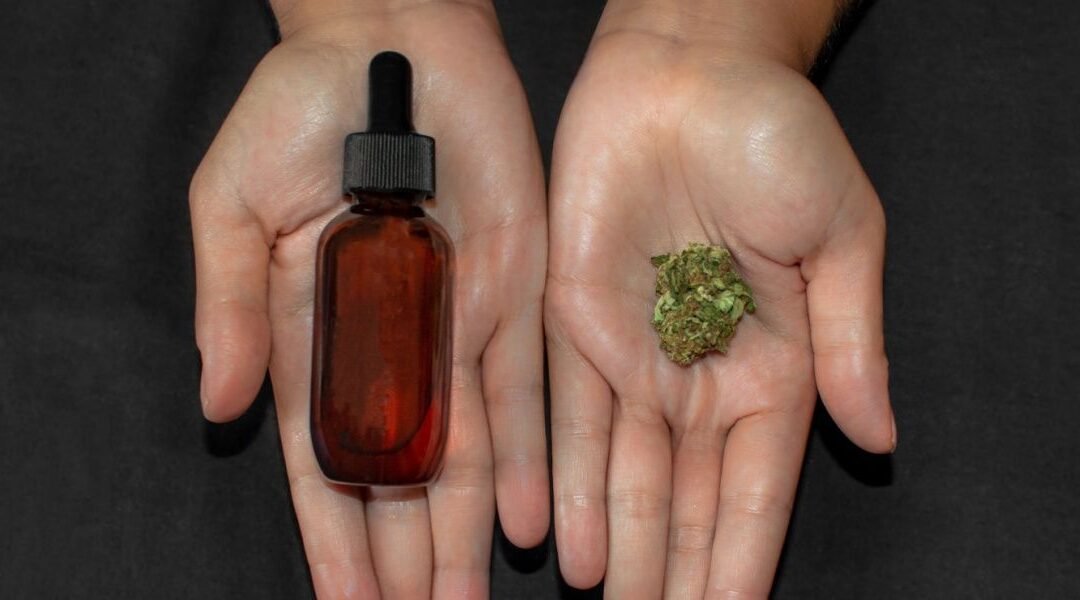
CBN vs THC is becoming an increasingly common comparison for people researching cannabis products, cannabinoids, vapes, oils, gummies and other cannabinoid formulations.
Although both CBN (cannabinol) and THC (tetrahydrocannabinol) are naturally occurring cannabinoids found in cannabis, they are not the same compound and should not be treated as interchangeable.
THC is best known for its intoxicating effects, while CBN has attracted attention as a minor cannabinoid frequently marketed around relaxation and sleep. However, some of the claims surrounding CBN are considerably stronger than the current human evidence supports.
So which is the better cannabinoid?
The answer depends on what you are actually comparing: intoxicating effects, cannabinoid profile, product type, laboratory testing, legal status or the evidence behind specific claims. Read our Indica Vs Sativa Vs Hybrid Guide
CBN vs THC at a Glance
| Feature | CBN | THC |
|---|---|---|
| Full name | Cannabinol | Tetrahydrocannabinol |
| Naturally occurring cannabinoid | Yes | Yes |
| Intoxicating potential | Lower than THC, but not necessarily zero | Stronger intoxicating effects |
| Common product positioning | Relaxation, night-time products, minor-cannabinoid formulations | Recreational and medical cannabis products |
| Psychoactive effects | Evidence is limited and mixed | Well established |
| Research base | Relatively limited | Much larger |
| Sleep claims | Evidence remains insufficient | Effects on sleep are complex and not a simple treatment claim |
| Drug testing considerations | Can cross-react with some THC immunoassays | Detectable through THC/metabolite testing |
| Product quality | Depends on formulation and testing | Depends on formulation and testing |
The biggest distinction is straightforward: THC has a much stronger and better-established intoxicating effect, whereas CBN is a less-studied minor cannabinoid with a different evidence base.
What Is CBN?
CBN stands for cannabinol.
It is a naturally occurring cannabinoid found in cannabis and is often described as a minor cannabinoid because it generally occurs in lower concentrations than major cannabinoids such as THC.
CBN can also be formed through the degradation or transformation of THC over time.
This is one reason older cannabis material can contain measurable CBN.
Modern cannabinoid products may also be specifically formulated to contain CBN, allowing manufacturers to market CBN as a standalone or blended cannabinoid.
What Is THC?
THC, usually referring to delta-9-tetrahydrocannabinol, is the principal intoxicating cannabinoid in cannabis.
It has a substantially larger scientific literature than CBN and is well known for producing changes in perception, cognition and subjective intoxication.
Research comparing cannabinoids indicates that THC has substantially different receptor activity and a stronger relationship with CB1-mediated effects than many other cannabinoids.
This makes THC fundamentally different from simply choosing a product containing a minor cannabinoid such as CBN.
The Biggest Difference Between CBN and THC
The most important difference is how strongly the two cannabinoids are associated with intoxication and their effects on the body’s cannabinoid system.
THC has a well-established intoxicating profile.
CBN is different.
Although CBN interacts with cannabinoid receptors and has shown cannabinoid-like activity in laboratory research, the human evidence is much more limited. Recent research reviews continue to describe the evidence base for CBN as insufficient for firm clinical recommendations.
Therefore, it would be misleading to describe CBN simply as “THC without the high.”
The two molecules are chemically related, but their pharmacology and real-world evidence are not identical.
CBN vs THC: Psychoactive Effects
This is one of the most important comparisons for consumers.
THC
THC is strongly associated with psychoactive and intoxicating effects.
Depending on the product, concentration and individual factors, THC can affect:
- Perception
- Attention
- Memory
- Coordination
- Mood
- Time perception
- Subjective intoxication
The effects can vary substantially between individuals.
CBN
CBN is generally considered considerably less intoxicating than THC, but saying that CBN has no psychoactive activity whatsoever would oversimplify the science.
Research has demonstrated that CBN can interact with cannabinoid receptors, and experimental studies have identified some THC-like activity under certain conditions.
The important distinction is that the evidence for CBN’s human effects is much less developed than the evidence for THC.
CBN vs THC for Sleep: What Does the Evidence Actually Say?
This is where cannabinoid marketing often becomes confusing.
CBN products are frequently promoted as sleep cannabinoids.
However, the scientific evidence does not currently justify treating CBN as a proven sleep treatment.
A 2021 review specifically examining CBN and sleep found that the available human research was limited and outdated, with few rigorous studies directly evaluating sleep outcomes. The review concluded that there was insufficient evidence to support sleep-related claims for CBN.
More recent research continues to describe the clinical evidence for CBN as minimal.
This means there is an important distinction between:
“CBN is marketed for sleep”
and
“CBN is clinically proven to treat insomnia.”
Those statements are not equivalent.
Does THC Work Better Than CBN?
There is no simple “better” cannabinoid.
THC has considerably more evidence regarding its pharmacological and intoxicating effects, but that does not mean it is automatically preferable for every consumer or every product category.
Likewise, the limited evidence for CBN does not mean that CBN products are ineffective.
It means that stronger claims require stronger evidence.
When comparing the two, consider what you are actually looking for:
- Intoxicating effects
- Non-intoxicating cannabinoid options
- Minor-cannabinoid formulations
- Product composition
- Laboratory testing
- Legal status
- Personal circumstances
CBN vs THC: How They Interact With Cannabinoid Receptors
Both cannabinoids interact with the body’s endocannabinoid system, but their pharmacological profiles are different.
THC has strong relevance to the CB1 receptor, which is closely associated with its psychoactive effects.
CBN also interacts with CB1 and CB2 receptors, although its receptor activity and overall pharmacology differ from THC. Research into phytocannabinoid receptor binding continues to demonstrate meaningful differences between cannabinoids.
This is one reason why it is inaccurate to treat all cannabinoids as interchangeable.
A product containing CBN is not simply a weaker version of a THC product.
CBN vs THC Products: What Can You Actually Buy?
The cannabinoid itself is only one part of a finished product.
CBN and THC can appear in different product formats, including:
- Oils
- Tinctures
- Capsules
- Gummies
- Vapes
- Flower
- Extracts
- Blended cannabinoid formulations
The formulation can dramatically change the product’s characteristics.
For example, a product containing CBN may also contain CBD, THC, terpenes or other minor cannabinoids.
Therefore, looking only at the front of the package can provide an incomplete picture.
CBN vs THC Vapes
Vapes are particularly important when comparing cannabinoid products because formulations can vary significantly.
A product marketed as a CBN vape may contain CBN alongside other cannabinoids or ingredients.
A THC vape may similarly contain THC alongside terpenes, minor cannabinoids or other components.
When comparing products, look beyond the cannabinoid name.
Check:
- Cannabinoid concentration
- Ingredients
- Extract type
- Terpene information
- Batch information
- Laboratory testing
- Manufacturer information
A Certificate of Analysis can be especially useful for determining whether the advertised cannabinoid profile corresponds with laboratory results.
CBN vs THC: Why COAs Matter
A Certificate of Analysis (COA) can provide much more useful information than marketing language.
Depending on the laboratory, a cannabinoid COA may provide results for:
- THC
- CBN
- CBD
- CBG
- Other cannabinoids
- Terpenes
- Residual solvents
- Heavy metals
- Pesticides
- Microbial contaminants
For commercial cannabinoid products, this information can help consumers distinguish between a clearly documented formulation and a product relying primarily on promotional claims.
A particularly important detail is whether the COA corresponds to the specific product or batch being evaluated.
CBN and THC Drug Testing
Another important difference is drug testing.
It is a mistake to assume that a product containing CBN is automatically irrelevant to THC drug testing.
Research has found that CBN can cross-react with certain urine immunoassays designed to detect THC metabolites. The amount required for a positive signal varies by assay.
Therefore, anyone subject to workplace, sporting, legal or other drug testing should not assume that a CBN-labelled product is necessarily risk-free from a testing perspective.
Laboratory confirmation methods can distinguish cannabinoids more specifically than screening immunoassays.
CBN vs THC: Which Has More Research?
There is a substantial difference in the amount of scientific evidence available.
THC:
THC has been studied extensively for decades, including its pharmacology, effects, risks, metabolism and medical applications.
CBN:
CBN has a considerably smaller evidence base, particularly when it comes to modern controlled human studies.
A recent 2026 review of cannabinoid evidence described the evidence for CBN as minimal and insufficient to support clinical recommendations, while noting substantially stronger evidence for THC-related psychiatric risks.
This does not make CBN uninteresting.
It simply means that consumers should distinguish emerging cannabinoid research from established clinical evidence.
CBN vs THC: Which Is More Potent?
“Potent” can mean different things.
If potency means intoxicating effect, THC is the clear point of comparison because THC is strongly associated with intoxication.
If potency means how much CBN is contained in a product, that is a different measurement entirely.
A product containing a high percentage of CBN should not automatically be described as more powerful than a THC product.
The cannabinoids produce different pharmacological profiles.
Is CBN Better Than THC?
There is no universal winner.
CBN may appeal to consumers researching minor cannabinoids and products marketed around relaxation, but its evidence base is still developing.
THC has much stronger evidence for its pharmacological and intoxicating effects, but it also carries significant risks and legal restrictions depending on the jurisdiction.
The more useful question is:
Which cannabinoid matches the product characteristics and evidence you are actually looking for?
CBN vs THC for Commercial Cannabinoid Products
From a product-comparison perspective, CBN and THC occupy different positions.
CBN is increasingly used as a minor-cannabinoid marketing ingredient, particularly in products positioned around night-time or relaxation themes.
THC remains the dominant cannabinoid associated with traditional cannabis products and intoxicating effects.
For consumers researching either category, product transparency should be a priority.
Look for:
- Accurate cannabinoid percentages
- Full ingredient lists
- Independent laboratory testing
- Batch-specific COAs
- Manufacturer information
- Clear product labelling
- Appropriate legal information
CBN vs THC: Common Marketing Claims to Question
Cannabinoid marketing can sometimes turn preliminary research into definitive-sounding statements.
Be cautious with claims such as:
- “CBN is a natural sleeping pill”
- “CBN guarantees better sleep”
- “CBN is completely non-psychoactive”
- “CBN has no drug-test implications”
- “THC is always better because it is stronger”
- “More cannabinoids automatically means a better product”
- “Higher potency means higher quality”
Scientific evidence rarely supports such absolute statements.
A better approach is to distinguish between what is known, what is being researched and what is simply marketing language.
CBN vs THC in the UK
UK readers should also consider legality separately from cannabinoid science.
The legal position of a cannabinoid product depends on the exact substance, formulation, concentration, intended use and applicable UK legislation.
THC-containing cannabis products are subject to UK controlled-drug laws, so a commercial product should not be assumed to be legal simply because it is sold online or labelled as a cannabinoid product.
CBN products also should not automatically be treated as legally interchangeable with ordinary CBD products.
For anyone researching cannabinoid products in the UK, it is important to check the current regulatory position rather than relying on a product description.
CBN vs THC: Which Cannabinoid Should You Choose?
There is no scientifically responsible one-size-fits-all answer.
If your priority is understanding intoxicating cannabinoids, THC is the more established compound.
If your interest is in minor cannabinoids and emerging cannabinoid formulations, CBN is an increasingly relevant compound to research.
But consumers should be especially cautious about products marketed with strong health or sleep claims because the evidence for CBN remains limited.
For commercial product comparisons, the strongest approach is to evaluate the actual formulation rather than choosing based solely on the cannabinoid name.
Frequently Asked Questions
Is CBN the same as THC?
No. CBN and THC are different cannabinoids with different chemical and pharmacological characteristics.
Does CBN get you high?
CBN is generally much less intoxicating than THC, but it should not simply be described as completely devoid of psychoactive activity. Experimental research has identified some THC-like activity, while human evidence remains limited.
Is CBN better for sleep than THC?
There is currently insufficient clinical evidence to say that CBN is a proven or universally better sleep cannabinoid. Research specifically examining CBN and sleep remains limited.
Does CBN show up on a drug test?
Some CBN can cross-react with certain THC-metabolite urine immunoassays. Anyone subject to drug testing should not assume that CBN products are automatically exempt from testing concerns.
Which is stronger, CBN or THC?
If you mean intoxicating effects, THC has the much stronger established psychoactive profile. CBN should not simply be ranked as a weaker form of THC because the compounds have different pharmacological profiles.
Can CBN products contain THC?
Some formulations can contain multiple cannabinoids, so the product label and laboratory report should be checked rather than assuming a CBN product contains CBN alone.
Should I choose a CBN or THC product?
That depends on the product, cannabinoid profile, legal status and what you are researching. There is no universal cannabinoid that is best for everyone.
Final Verdict: CBN vs THC
The CBN vs THC debate becomes much clearer when marketing claims are separated from the underlying science.
THC is the better-established intoxicating cannabinoid and has a substantially larger research base.
CBN is a minor cannabinoid that has attracted significant commercial interest, particularly around relaxation and sleep-related products, but the human evidence supporting many of those claims remains limited.
For anyone comparing cannabinoid products, the best approach is not simply to ask which cannabinoid is “stronger.”
Instead, look at:
- Cannabinoid content
- Product formulation
- Ingredients
- COA documentation
- Laboratory testing
- Manufacturer transparency
- Legal status
- Evidence supporting the product’s claims
Ultimately, CBN and THC are different cannabinoids with different profiles—not competing versions of exactly the same product.
Recommended internal links:
- What Is CBN?
- What Is THC?
- CBN vs CBD
- CBN vs HHC
- CBN for Sleep: What Does the Evidence Say?
- THC Vape COA Guide
- THC Vape Laws UK 2026
- Cannabis Cannabinoids Explained
- Indica vs Sativa vs Hybrid
- THC Vape vs CBD Vape