
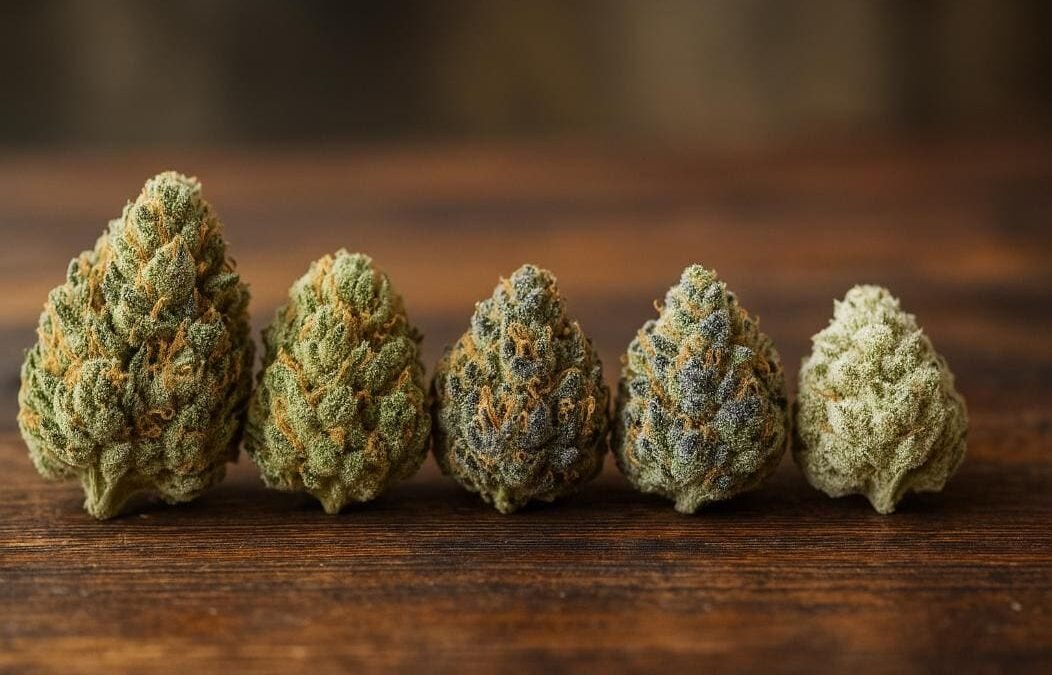
If you’re researching strong weed strains, you’ve probably noticed that cannabis varieties are no longer judged simply by whether they are Indica, Sativa or Hybrid. Modern cannabis products can differ substantially in THC concentration, terpene composition, cannabinoid profile, cultivation quality and overall potency.
That makes choosing a strong cannabis strain more complicated than simply looking for the highest THC percentage.
In this Sluggers Vapes guide, we’ll look at some of the cannabis strains commonly associated with high potency and explain what makes a strain appear particularly strong, how THC percentage should be interpreted, why terpene profiles matter and what to look for when comparing products.Browse our THC Flower vs Vapes
What Makes a Weed Strain Strong?
The term “strong weed strains ” usually refers to cannabis with a relatively high concentration of THC, the primary intoxicating cannabinoid in cannabis.
However, THC percentage isn’t the only factor that determines how a product is experienced.
Important characteristics include:
- THC concentration
- Other cannabinoids
- Terpene composition
- Product consistency
- Cultivation and curing quality
- Laboratory testing
- Product format
Scientific research generally finds that higher-potency cannabis is associated with increased risks of problematic cannabis use, while evidence concerning several other health outcomes remains more variable.
Therefore, the strongest product on a label isn’t necessarily the best-quality product.
Top Strong Weed Strains to Know
There are hundreds of cannabis cultivars available internationally, but several names are repeatedly associated with high-potency cannabis markets.
1. Godfather OG
Godfather OG is one of the names frequently associated with high-potency cannabis.
It is generally described as an Indica-dominant cultivar and has developed a reputation for a strong cannabinoid profile.
For consumers researching strong strains, Godfather OG is worth understanding because it demonstrates an important distinction between strain reputation and independently verified potency.
A product marketed as Godfather OG can vary considerably depending on cultivation, genetics, harvest and testing.
2. Bruce Banner
Bruce Banner is another well-known cannabis cultivar associated with high THC levels.
The name has become particularly recognizable in cannabis culture and appears across flower, seed and other cannabis-product markets.
When evaluating Bruce Banner or any other high-potency strain, the actual laboratory result is more meaningful than relying solely on the cultivar name.
What to look for
Look for:
- Current laboratory testing
- THC and CBD results
- Cannabinoid profile
- Terpene information
- Batch identification
This can help distinguish a genuinely tested product from one relying primarily on marketing claims.
3. Girl Scout Cookies
Girl Scout Cookies, often abbreviated as GSC, is one of the best-known modern cannabis cultivars.
It has been associated with relatively high THC concentrations and has influenced numerous subsequent hybrids.
Its popularity also demonstrates why strain names alone aren’t enough to determine potency.
Different growers and producers can sell products under the same cultivar name while producing different cannabinoid and terpene profiles.
4. Gorilla Glue
Gorilla Glue, also known as GG4, is another cultivar frequently discussed in relation to strong cannabis.
It is generally associated with a potent hybrid profile and has become one of the more recognizable names in modern cannabis culture.
For commercial cannabis research, Gorilla Glue is particularly useful as an example of how a cultivar’s reputation can become a major part of its market identity.
5. Wedding Cake
Wedding Cake is a popular hybrid cultivar known for its dessert-style name and commonly reported sweet, creamy and earthy aromatic profile.
It is frequently discussed among higher-potency cannabis varieties.
However, consumers should distinguish between:
Cultivar reputation
and
Actual laboratory-tested potency.
A strain name does not guarantee a particular THC percentage.
6. Gelato
Gelato has become one of the most recognizable modern cannabis cultivar families.
Its popularity has resulted in numerous related varieties and crosses, meaning that products carrying the Gelato name can have substantially different cannabinoid and terpene profiles.
This makes Gelato an especially good example of why product-specific testing matters.
Gelato and THC potency
Some Gelato products can be relatively high in THC, but the actual percentage depends on the specific cultivar, producer and batch.
Rather than assuming that every Gelato product is extremely potent, check the laboratory results for the specific product.
7. Runtz
Runtz is another widely recognized modern cultivar.
It is particularly associated with sweet and fruity flavour characteristics and has become a common name across contemporary cannabis markets.
Runtz is also a good example of how flavour, aroma and potency can become interconnected in cannabis marketing.
A product can have an appealing terpene profile without necessarily being the highest-THC product available.
8. GMO
GMO, sometimes called Garlic Cookies, is known for its distinctive aromatic profile.
It is frequently described as having strong savoury, earthy and pungent characteristics rather than the sweet fruit profiles associated with varieties such as Runtz or Gelato.
For people researching strong strains, GMO is worth including because potency and flavour are separate characteristics.
A strain can be powerful without having a sweet or fruity terpene profile.
9. Zkittlez
Zkittlez is widely recognized for its sweet, fruit-forward aromatic profile.
Although it is often discussed primarily for flavour, certain Zkittlez-related products can also have relatively high THC concentrations.
This highlights another important point:
High THC and strong flavour aren’t the same thing.
Terpenes influence aroma and flavour, while THC is the primary intoxicating cannabinoid.
10. OG Kush
OG Kush is one of the foundational names in modern cannabis culture.
It has influenced numerous later cultivars and hybrids and remains one of the most recognizable strain names.
Because OG Kush has been reproduced by many growers, the characteristics of products sold under the name can vary considerably.
For that reason, laboratory testing remains more useful than the strain name alone when comparing potency.
Strong Weed Strains Compared
| Strain | Common classification | Typical reputation | Common flavour direction |
|---|---|---|---|
| Godfather OG | Indica-dominant | High potency | Earthy, pungent |
| Bruce Banner | Hybrid | High potency | Sweet, earthy |
| Girl Scout Cookies | Hybrid | High potency | Sweet, earthy |
| Gorilla Glue | Hybrid | Strong | Earthy, pungent |
| Wedding Cake | Hybrid | High potency | Sweet, creamy |
| Gelato | Hybrid | High potency | Sweet, fruity |
| Runtz | Hybrid | Potent modern cultivar | Sweet, fruity |
| GMO | Indica-dominant hybrid | Strong | Savoury, pungent |
| Zkittlez | Hybrid | Potent cultivar family | Fruity, sweet |
| OG Kush | Hybrid | Strong classic cultivar | Earthy, piney |
Important: These are broad cultivar reputations, not guaranteed THC rankings. Actual potency can vary substantially between producers, harvests and batches.
Is Higher THC Always Better?
No.
This is one of the biggest misconceptions surrounding strong cannabis.
A higher THC percentage means a product contains more THC by weight, but it doesn’t automatically mean the product is higher quality.
Research examining high-potency cannabis has found associations between higher potency and problematic cannabis use, while the evidence for some other health outcomes is less consistent.
A better way to evaluate cannabis quality is to consider several characteristics together:
THC
Provides information about cannabinoid concentration.
Terpenes
Provide information about the aromatic profile.
Cannabinoid balance
THC isn’t the only cannabinoid present in cannabis.
Laboratory testing
Independent testing can provide information about cannabinoid concentrations and potential contaminants.
Product consistency
A reliable producer should be able to provide consistent batch information.
THC Percentage vs Strain Strength
A common search phrase is “highest THC strain.”
But THC percentage should be interpreted carefully.
For example, two products could both be marketed as the same cultivar while testing at different THC concentrations.
This can happen because of differences in:
- Genetics
- Growing conditions
- Harvest timing
- Curing
- Storage
- Testing methodology
Consequently, a strain name isn’t a laboratory measurement.
The most useful information is the current COA for the specific batch.
Why Terpenes Matter When Comparing Strong weed Strains
Cannabis isn’t just about THC.
Terpenes are aromatic compounds that contribute to the smell and flavour profile of different cultivars.
Common cannabis-associated terpenes include:
- Myrcene
- Limonene
- Caryophyllene
- Pinene
- Linalool
This helps explain why two products with similar THC percentages can smell and taste completely different.
For a commercial product comparison, therefore, it makes sense to evaluate both:
Potency + terpene profile
rather than focusing exclusively on THC.
How to Compare Strong Cannabis Products
If you’re researching cannabis products in a jurisdiction where they are legally available, there are several characteristics worth comparing.
Check the COA
A Certificate of Analysis can provide information about:
- THC
- CBD
- Other cannabinoids
- Terpenes
- Contaminant testing
- Batch information
A COA should correspond to the actual product or batch rather than being a generic document unrelated to the item being sold.
Look Beyond the THC Number
A high THC percentage doesn’t tell you everything about product quality.
Look at the entire cannabinoid and terpene profile.
Check the Product Date
Cannabis chemistry can change during storage.
Exposure to light, oxygen and unsuitable temperatures can contribute to changes in cannabinoids and terpenes over time.
Compare Cultivar Information
Don’t assume that every product carrying the same strain name is identical.
Different producers can create substantially different versions of the same cultivar.
Strong Weed Strains vs High-Quality Weed
These terms are not interchangeable.
Strong weed strains generally refers to potency.
High-quality weed can refer to a much broader set of characteristics, including:
- Clean cultivation
- Appropriate curing
- Good aroma
- Consistent appearance
- Accurate labelling
- Independent laboratory testing
- Appropriate storage
- Absence of unwanted contaminants
A product can therefore be highly potent without necessarily being high quality.
Are Strong Weed Strains Legal in the UK?
This requires particular caution.
Cannabis remains a Class B controlled drug in the UK. UK government guidance states that companies wishing to possess, manufacture, produce, supply, import or export relevant controlled cannabis products generally require the appropriate controlled-drug licence, subject to specific legal arrangements and exemptions.
The UK’s industrial hemp framework also does not simply make cannabis flower commercially legal; the Home Office guidance specifically describes the framework as relating to seed and fibre production.
The UK government has also addressed THCA and semi-synthetic cannabinoids separately, following advice from the Advisory Council on the Misuse of Drugs.
Therefore, a US cannabis strain’s popularity or THC percentage does not establish that the corresponding product is lawful to sell or possess recreationally in the UK.
Strong Weed Strains: Frequently Asked Questions
What is the strongest weed strain?
There is no universally reliable answer because cannabis potency varies between genetics, producers and individual batches. A current laboratory result is more meaningful than a strain name or online ranking.
Which strains are known for high THC?
Godfather OG, Bruce Banner, Girl Scout Cookies, Gorilla Glue, Wedding Cake, Gelato and several other modern cultivars are commonly associated with high-potency cannabis.
Does higher THC mean a stronger high?
THC concentration is an important factor in intoxicating potential, but it isn’t the only characteristic involved. Product format, individual response and other cannabinoids can also matter.
Is 30% THC considered strong?
A flower product labelled around 30% THC would generally be considered high potency compared with lower-THC flower. However, labels should be verified against reliable laboratory testing.
What is more important: THC or terpenes?
They provide different information. THC describes cannabinoid concentration, while terpenes primarily describe aromatic characteristics. Neither measurement alone completely describes a cannabis product.
Are strong cannabis strains legal in the UK?
Not simply because they are sold or advertised elsewhere. Cannabis is controlled under UK law, and lawful cannabis-based medicines operate under specific medical and regulatory arrangements.
Final Thoughts
The search for strong weed strains often focuses on one number: THC percentage.
But a better product-information approach is to look at the complete picture.
Cultivar genetics, cannabinoid concentration, terpene composition, laboratory testing, product quality and regulatory status all matter.
Names such as Godfather OG, Bruce Banner, Girl Scout Cookies, Gorilla Glue, Wedding Cake, Gelato, Runtz, GMO, Zkittlez and OG Kush are widely recognized in discussions of potent cannabis, but their actual characteristics can vary considerably between products and batches.
For anyone researching cannabis commercially, “strongest” should therefore be treated as a product characteristic to verify rather than a marketing promise.
Suggested internal links:
- What Is THC?
- THC Percentage Explained
- Indica vs Sativa vs Hybrid
- High-Quality THC Flower
- THC Flower COA Guide
- How to Store THC Flower
- Fake THC Flower
- THC Flower vs Vapes
- UK THC Flower Laws 2026
- UK Cannabis Laws 2026